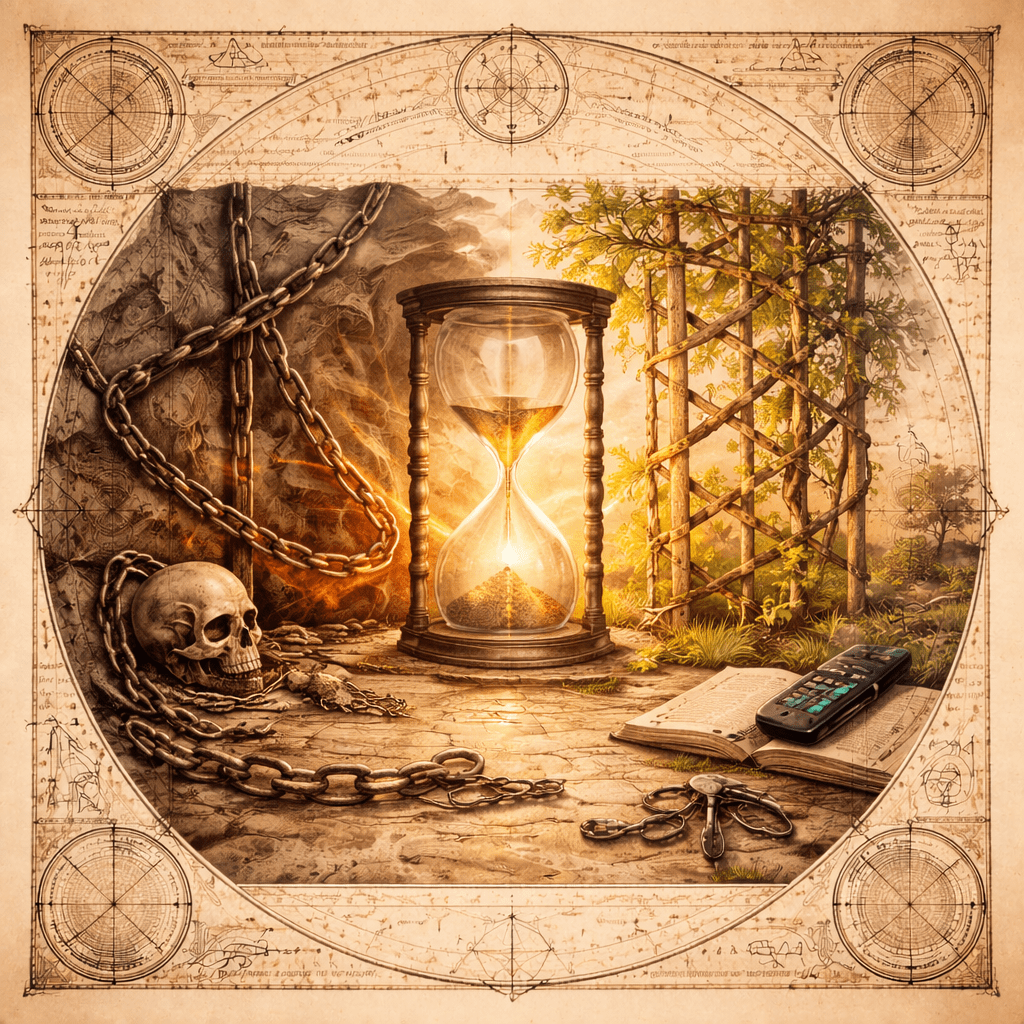
Section I — Scarcity and the Last Constraint
For millions of years, the Fear of Not Having Enough was law. It was carved into bone and marrow long before words or cities, long before reason could question its rule. To hesitate when food was offered, to fail to store against winter, to misjudge the turning of the seasons—this was death. Fear kept the body alive. Hunger was its enforcement, and survival was its verdict.
But instincts do not expire when the world changes. They linger, etched deep, even when their decree no longer matches reality. And so in an age where fields overflow and storehouses groan, the old fear still commands. Abundance is not experienced as fullness but as panic—panic that what is present will be lost, panic that the feast only proves how empty the next famine will feel. Fear distorts plenty into proof of what cannot be kept.
Beneath this distortion stands the last constraint: time. Death does not yield to surplus. No harvest can be stored against its approach. It is the final scarcity, the Great Time Constraint, and its shadow stretches over every table. No matter how much abundance surrounds you, the whisper endures: This too will vanish.
And so the ancient law lives on, disguised in modern forms. Fear of Not Having Enough. Fear of Time. Together, they warp abundance into anxiety and turn every gift into a reminder of its inevitable loss.
Section II — The Fear of Constraint
When scarcity and time overlap, they do not dissolve into safety. They reveal something even more fundamental: the Fear of Constraint itself. It is not just hunger or death that terrifies—it is the reminder that life is bounded at all.
People feel every boundary as an echo of mortality’s final gate. A fence around appetite, a rule against action, even the gentle word no—all shimmer with the shadow of death. To be told “you cannot” feels like the whisper “you will not endure.” And so boundaries are treated as cages, even when they are scaffolds.
But here is the truth that fear hides: every life is bounded. Constraint is not a punishment—it is existence itself. The body cannot defy gravity. The mind cannot outrun time. The question is not whether limits exist. The question is who authors them.
Fear resists and delays until collapse imposes the limit anyway. Will steps forward and names the boundary as its own, choosing the scaffold to grow around before the imposed chains descend. One path shrinks liberty to nothing. The other engraves it deeper with every chosen line.
Section III — Liberty Misunderstood
People speak of liberty as if it were the absence of limits. They mistake the desert, endless and unbounded, for freedom. But true liberty is not the erasure of lines. It is the authorship of them. Liberty is the act of choosing which constraints will shape you, and which you will refuse.
Self-constraint is not captivity. It is scaffolding. It is the chosen line that opens space. Space to move, to grow, to choose—to be free. The vow you bind to yourself becomes the structure that keeps you free. Fear, by contrast, rejects the vow and waits for collapse. In doing so it forges chains—chains heavier and harsher than any chosen scaffold. Chains that pull you where fear wants you to go.
This truth is mirrored even in myth. Batman’s vow not to kill is not weakness. It is sovereignty. His self-imposed rule allows him to break laws and defy institutions without becoming indistinguishable from the chaos he fights. The Joker, by contrast, rejects all limits, mistaking impulse for liberty. Yet he is not free. He is enslaved to reaction, a captive to every passing whim. His so-called freedom is nothing but fear’s chains disguised as mindless self-indulgence.
The same law plays out in ordinary lives. A man may claim freedom in eating without restraint, two hamburgers every day for lunch, calling it liberty from imposed limits. “I do what I want.” But the liberty he clings to is an illusion. In time, diabetes and an early death will close in, imposing a harsher captivity—one enforced not by Will, but by collapse. He was not free. His reckoning was merely lying in wait.
Liberty is not life without constraint. It is life with constraints chosen by Will. To refuse this truth is to surrender authorship and to accept chains forged by fear.
Section IV — The Breathalyzer Paradox
Nowhere is the Fear of Constraint more visible than on the roads. Everyone knows drunk driving kills. Laws exist, but they are porous, enforced only after the damage is done. And yet the solution already exists: technology could prevent a drunk driver from starting a car at all. A simple breathalyzer built into every vehicle would end the gamble.
But society rejects this solution of societal self constraint. Not out of ignorance—out of fear. The Fear of Constraint whispers beneath the surface: “If they can stop me here, they can stop me anywhere. If this gate closes, others will follow. Soon I will not be living, I will only be confined.” But constraint is not the same as confinement. Constraint is a trellis—something to grow around. Confinement is a cell—something you wither in.
External constraints become necessary when individual’s judgment is compromised or many individuals lack of self-constraint negatively impacts others. But still even when judgment is impaired, even when lives are at stake—we trust a drunk person’s judgment to determine if they drive or not. People cling to the illusion that liberty means leaving every gate unlocked—regardless of if the person is a danger to themselves or others.
The truth is harsher. The mentally ill have societal self constraints imposed before they do any harm. These constraints act as scaffolding to prevent potential harm. The breathalyzer thought experiment is the same preventative idea, it creates a scaffolding that only constrains people actively trying to drive drunk and are likely to cause harm. Refusing the scaffold of prevention is not freedom. It is surrender to chains forged by collapse—lives destroyed, families broken, liberty ended not by law but by death. Yet the illusion persists, fear disguised as liberty, defending the “right” to make bad choices—over the responsibility to author better constraints.
The paradox is clear: people claim to value life and justice, but their deeper allegiance is to unrestricted choice—even when that choice serves fear, not freedom and is born of vice, not virtue. They would rather face the chain of tragedy than accept the scaffold of prevention. Fear masquerades as liberty, and society kneels before it.
Section V — The Law of Chosen Constraint
The answer to fear is always Will, and with Will comes vulnerability. Vulnerability is not weakness—it is liberty in practice. It is the courage to open the gate by choice, rather than wait for collapse to tear it from its hinges. To be vulnerable is to author the limit yourself, to declare: “Here I am. I will step out of my armor and leave the chains of fear. I will grow around this scaffold—made by my own Will—so that I may remain free.”
The law is inescapable: you will be constrained. One way or another. The only question is whether you bind yourself with scaffolds chosen by your Will, or whether you are bound by chains born of fear, enforced by time, imposed by consequence.
The man who refuses discipline in consumption finds himself captive to diabetes. The driver who clings to the “freedom” to start a car drunk may never drive again, or may rob another of their liberty forever. These are not exceptions. They are the rule. Fear rejects the scaffold and forges the chain. Will accepts the scaffold and expands liberty by using it.
Epilogue — The Axiom
Every liberty requires a chosen constraint. Without it, liberty is illusion—and time will rip it away.
Scarcity was the second decree. It eventually carved the Fear of Not Having Enough into bone, teaching bodies to hoard, to cling, to fear the empty hand. Time is the inescapable decree. It was the first decree and it will be the last. Death still rules as the Great Time Constraint, casting a shadow no abundance can erase. Beneath them both lies the deeper terror—the Fear of Constraint itself. To be limited at all feels like captivity, because every boundary echoes mortality’s final gate. And so abundance mutates into anxiety, and excess is read not as freedom, but as proof of what will be lost.
But liberty is not life without limits. Liberty is authorship—the choice of which constraints will shape you. Vulnerability is not weakness. It is freedom in practice, the courage to open the gate by Will rather than collapse. Refuse to choose, and fear forges chains heavier than any scaffold. Accept the scaffold, and you are free to grow around it. This is the law.
The lesson is not abstract. Batman’s vow not to kill crowns him with sovereignty. Joker’s rejection of all limits leaves him enslaved to impulse, captive to reaction, bound by chaos he calls freedom. A man who eats without restraint condemns himself to diabetes, decay, and an early grave. The one who binds himself to discipline lives longer, freer. One path is Will; the other is fear.
The Breathalyzer proves the law at scale. Everyone knows drunk driving kills. Technology could prevent it. Yet society resists—not out of ignorance, but from the Fear of Constraint. Better to guard the illusion of liberty—the “freedom” to make a poor choice—than accept the scaffold that preserves real freedom for all. And so fear wins again, masquerading as liberty, kneeling whole nations before its lie.
This is the final verdict: you will be constrained. Either you set the scaffold yourself, or you are bound by the chains. Either you choose the line, or collapse draws it for you.
Every liberty requires a chosen constraint. Without it, liberty is illusion—and time will rip it away.
 the Gist…