“Simple rules applied repeatedly can generate structures of astonishing richness.”
I. Introduction — When Simple Numbers Generate Complexity
Some of the most intricate mathematical structures arise from remarkably simple numerical beginnings. Recursive sequences, substitution tilings, and non-periodic geometric patterns often start with only a few integers and a rule for how they interact. From these small ingredients, systems can emerge that exhibit scaling, asymmetry, and unexpectedly rich structure.
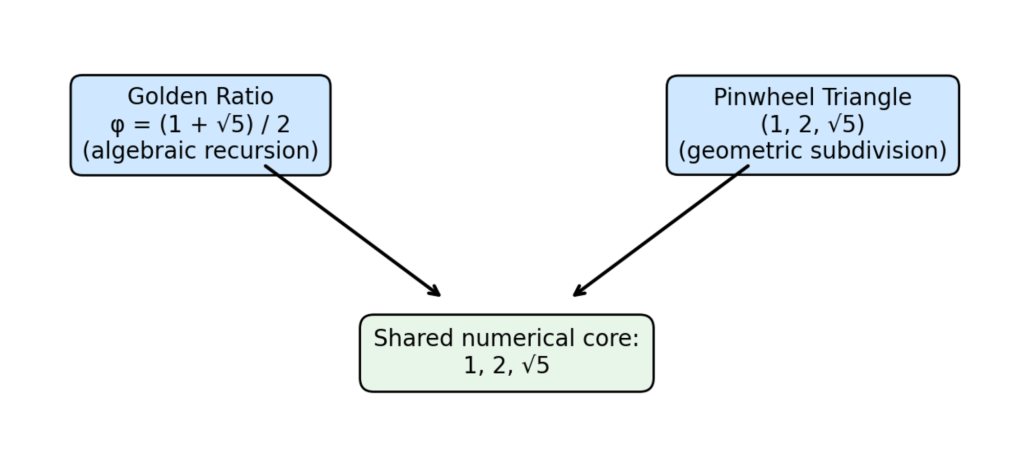
One intriguing example involves the numerical set (1, 2, √5). These numbers appear independently in two very different mathematical constructions: the algebraic formula for the golden ratio and the geometric triangle underlying Conway’s pinwheel tiling.
The integers 1 and 2, together with the irrational length √5 determined by
1² + 2² = 5
therefore appear in both an algebraic growth law and a geometric substitution rule. The significance of this observation is not that one construction derives from the other, but that the same small numerical configuration appears independently in two systems capable of generating complex mathematical structure.
II. The Algebraic Appearance: The Golden Ratio
One familiar appearance of 1, 2, and √5 occurs in the formula for the golden ratio.
φ = (1 + √5) / 2
This number arises naturally from the Fibonacci recurrence.
Fₙ₊₁ = Fₙ + Fₙ₋₁
As the sequence grows, the ratio between successive terms approaches a limiting value. That limiting value is the golden ratio.
The Fibonacci rule produces a system characterized by recursive growth. Each term depends on the previous two, creating a chain of dependencies that propagates indefinitely. Over time the sequence settles into a stable scaling relationship governed by φ, meaning that successive stages of the sequence become approximately self-similar.
This type of recursive scaling appears in several mathematical contexts. In phyllotaxis, rotations related to the golden angle produce efficient packing patterns in plants. In Penrose tilings and related quasi-periodic structures, geometric inflation rules introduce similar scaling behavior.
III. The Geometric Appearance: The Pinwheel Triangle
A second appearance of 1, 2, and √5 arises from elementary geometry. Consider the right triangle with side lengths,
(√5, 2, 1)
which follows directly from the Pythagorean relation.
1² + 2² = 5
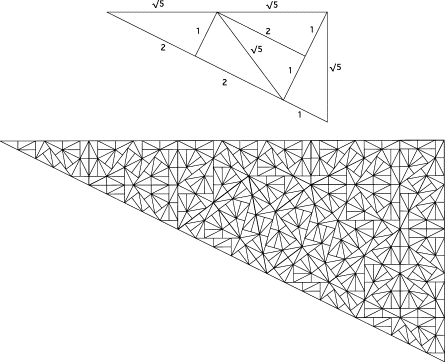
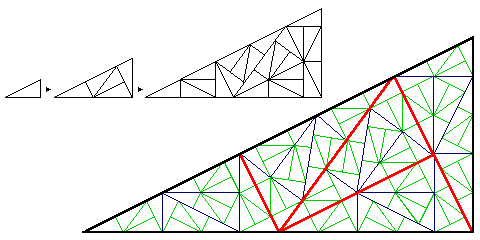
This triangle forms the basis of Conway’s pinwheel tiling. In this construction the triangle can be subdivided into five smaller triangles that are all similar to the original.
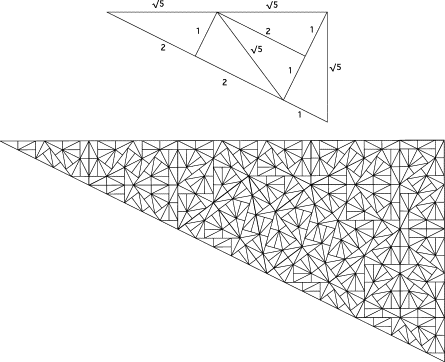
Source: https://www.researchgate.net/figure/At-each-decomposition-step-every-triangle-in-this-Conway-pinwheel-tiling-is-subdivided_fig2_259523798
Each subdivision introduces a scaling factor of 1/√5, so every iteration produces smaller copies of the same triangular shape. Repeating this subdivision indefinitely generates a recursive tiling of the plane.
Each substitution step rotates the triangle by the angle.
θ = arctan(1/2)
Because this rotation angle is irrational relative to π, repeated substitutions never cycle through a finite set of orientations. Instead the orientations of the triangles become dense in the plane, meaning that triangles appear at infinitely many distinct angles.
IV. The Geometric Appearance: Coordinate Geometry
A third appearance of the same numerical configuration arises in ordinary coordinate geometry. On the square grid of integer points, consider the line from the origin (0,0) to the point (1,2). By the Pythagorean relation
1² + 2² = 5
this line has length √5.
This direction can be understood in relation to the simplest integer directions on the grid. The lines from the origin to (1,0), (0,1), and (1,1) follow the horizontal, vertical, or diagonal symmetries of the square grid. The line to (1,2) is the first simple integer direction that does not follow any of these symmetries.
In this way the pair (1,2) produces the length √5 through a basic geometric construction. The same integers that appear in the Fibonacci recurrence and in the sides of the pinwheel triangle.
V. Two Independent Mechanisms
Although the same numerical set appears in both constructions, the mechanisms producing these systems are entirely different.
The golden ratio emerges from an algebraic process analyzing the long-term behavior of the Fibonacci recurrence. The pinwheel tiling begins with a geometric object: the right triangle with side lengths (1, 2, √5), which generates a tiling through recursive subdivision and scaling. The coordinate-geometry example reflects the same geometric relation in a simpler setting.
Thus the two systems arise from fundamentally different frameworks:
Algebraic
• algebraic recursion
• quadratic equation
• limiting growth ratio
Geometric
• geometric subdivision
• Pythagorean triangle
• substitution tiling
Neither construction derives from the other. Yet both contain the same numerical configuration.
VI. Why These Numbers Matter
The triangle (1, 2, √5) can be viewed as a minimal asymmetric configuration. Many geometric constructions built from highly symmetric triangles tend to produce repeating patterns. Equilateral or isosceles triangles often lead to periodic tilings because their angles and side lengths repeat regularly.
The triangle (1, 2, √5), however, breaks this symmetry. Its sides are all distinct, and the ratios between them do not reduce to simple symmetric proportions. This asymmetry allows the triangle to support directional behavior under recursive subdivision, including the rotations responsible for the dense orientation structure of the pinwheel tiling.
A related asymmetry appears in the Fibonacci recurrence. The rule
Fₙ₊₁ = Fₙ + Fₙ₋₁
introduces directional growth. Over time this asymmetric recursion stabilizes into the scaling relationship governed by the golden ratio.
VII. The Convergence
The same numerical configuration (1, 2, √5) appears in two independent mathematical mechanisms. One arises from algebraic recursion in the Fibonacci sequence, where √5 appears in the formula for the golden ratio. The other arises from Euclidean geometry through the Pythagorean relation, which produces the triangle (1, 2, √5).
This geometric relation appears in two different contexts. In coordinate geometry, the line from (0,0) to (1,2) has length √5 on the integer grid. In Conway’s pinwheel tiling, the same triangle (1, 2, √5) becomes the basis of a substitution rule that generates a recursive tiling of the plane.
These mechanisms are independent, yet the systems they generate share similar structural features:
• scaling
• recursion
• asymmetry
• complex structure
This phenomenon can therefore be described as a numerical convergence: independent constructions arriving at the same small set of numbers while producing systems with comparable generative behavior.
VIII. Philosophical Reflection
Complex systems often arise from simple rules applied repeatedly. Cellular automata, fractals, substitution tilings, and recursive sequences all show how small seeds can generate unexpectedly rich behavior.
The examples explored here suggest a more specific instance of that principle. The simple numerical configuration (1, 2, √5) appears independently within both an algebraic and a geometric generative system. In each case those numbers participate in mechanisms capable of producing scaling, recursion, and asymmetry.
The complexity of the resulting structures does not come from complicated ingredients. Instead it emerges from the repeated application of simple relationships.
IX. Conclusion
Across several independent mathematical settings the irrational length √5 appears in structures associated with recursive growth or asymmetric geometric structure. In the Fibonacci recurrence, the quadratic equation underlying the golden ratio introduces √5 as part of the expression
φ = (1 + √5)/2
which governs the limiting growth ratio of the sequence. In coordinate geometry, first simple integer direction is the line from (0,0) to (1,2). By the Pythagorean relation its length is √5. In this sense √5 appears naturally as the distance associated with the first simple direction that does not follow the horizontal, vertical, or diagonal symmetries of the grid creating asymmetry. In Conway’s pinwheel tiling, the triangle with sides 1, 2, and √5 generates a substitution rule whose repeated application produces infinitely many orientations.
These examples do not establish a universal mathematical law, nor do they imply that √5 plays a privileged role in every area of mathematics. What they reveal instead is a striking alignment: across several low-dimensional structures, the number 5 marks an early point at which symmetry gives way to recursion, scaling, or directional asymmetry. The repeated appearance of √5 in these independent constructions suggests that the integer 5 occupies a distinctive position among the smallest numbers capable of generating such behavior.
One further observation connects these constructions at an even simpler numerical level. The recursive rule underlying the Fibonacci sequence can equally be viewed as beginning with the pair (1, 2), which produces the sequence (1, 2, 3, 5, 8, 13…) the same numbers as the Fibonacci sequence after the initial duplication of 1. The same pair of integers generates the triangle (1, 2, √5) through the Pythagorean relation 1² + 2² = 5. In this sense the integers (1, 2) may be viewed as a minimal numerical seed appearing in both the algebraic recursion and the geometric construction examined here.
Taken together, these observations highlight how remarkably small numerical ingredients can generate unexpectedly rich structure. Beginning from the integers 1 and 2, the emergence of √5 appears across recursive growth, geometric proportion, coordinate geometry, and substitution tilings. Whether this convergence reflects deeper mathematical principles or simply the earliest complexity available in low-dimensional systems, the alignment itself is noteworthy and invites further exploration of how simple numerical seeds give rise to the patterns that structure mathematics.
 the Gist…