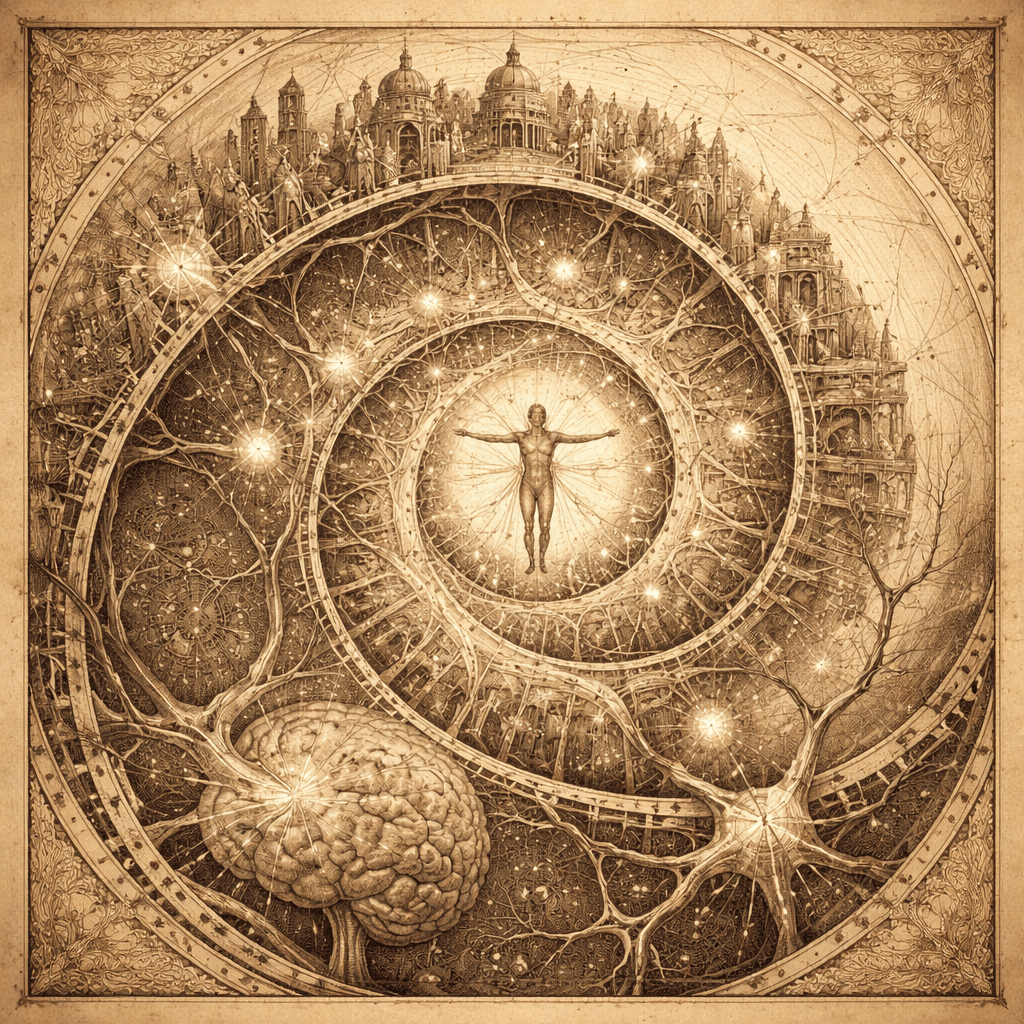
Introduction — The Spiral at Two Scales
You will be constrained. This is the first law.
Fear shrinks liberty by resisting constraint.
Will expands liberty by authoring constraint.
This truth does not live only in the body or the mind. It repeats. It spirals outward. What governs a single life also governs a people. What binds neurons in contest also binds nations in debate. Personal Will and collective Will are not opposites—they are mirrors of the same law at different scales.
The aim here is not to prove some grand metaphysic, but to demonstrate the unity of Will by identifying objective observable patterns and principles. Not by searching for the meaning or mechanism of consciousness, because Will is not consciousness. A tree has a Will to grow toward sunlight, but lacks consciousness.
The same methods that shape an individual—dissonance between impulses, deliberation among inner voices, scaffolding of vows, clarification of fear from value—are the very principles by which societies move. The medium of mechanism is not the same, but the pattern of principles is. The self and the polis are self-similar patterns, repeating, branching, converging.
Will significantly influences environmental conditions of thresholds. The environmental conditions of a threshold determine outcomes: a synapse firing or not firing, a voter voting yes or no, a tree branch’s growth or absence of growth. Will, like consciousness, cannot be directly observed, but its effects are all but undeniable.
The personal Wills of each individual synapse influences and works to create the collective Will of the voter—and all their synapses—and the collective Will of the voter influences the Will of the individual synapse. This is the same pattern as the personal Will of the voter influencing the collective Will of the society and the collective Will of the society influencing the personal Will of the voter.
This essay will trace that pattern. It will show how fracture, deliberation, and scaffold operate alike in one person and in many. It will show that fear shrinks both into collapse, and Will expands both into authorship. One law. One principle. Many scales.
Section I — Constraint and the Fractal of Thresholds
Every motion begins with a threshold. A neuron gathers signals, weighs them, and then fires or does not fire. Yes or no. This is not a monolithic command—it is a contest. One impulse pulls toward action, another toward restraint. The mind is not a single voice but a chamber of arguments, inner voices wrestling contradictions until one signal breaks through.
Society is no different. Citizens are thresholds, each weighing their own signals, each casting a yes or a no. Representatives gather these signals, deliberate, and pass judgment. Laws are not decreed from a single voice, but from a field of competing voices—societies arguing, negotiating, colliding until one line is drawn.
The pattern is the same at both scales. Whether neuron or citizen, whether individual or polis, Will emerges not from silence but from fracture. It is not the absence of contest but its presence that makes authorship possible.
Will is not monolithic in either scale. It is a field of thresholds in contest, a fractal lattice where every yes and no bends the shape of what comes next.
Section II — Fear’s Masquerade and Will’s Authorship
Fear hates the scaffold. It whispers that every boundary is a cage, that every line is a chain. And so when confronted with constraint, fear resists until collapse draws the line instead. What could have been a trellis to grow around becomes a prison that closes from outside.
Will acts differently. Will names the boundary first. It chooses scaffolds before collapse, binds itself in order to remain free. The line drawn by Will is not a chain—it is a chosen structure that expands liberty by preventing collapse from dictating the end.
You can see the masquerade in the smallest of choices. A man argues with himself over a cheeseburger. His hunger says yes, his health says no. Fear rejects the scaffold of restraint, calling it captivity, and so the cheeseburger is eaten again and again. But collapse waits. Diabetes, decay, early death—the chains of consequence that are heavier than any self-imposed scaffold could have been.
The same masquerade haunts the collective. Everyone knows surgical error kills. Everyone knows it is preventable. A mandatory “time-out” before incision closes the gate only to the surgeon rushing past review. Yet fear whispers that such a scaffold is a chain—that if this pause is required, others will follow. Better to leave all gates open, even if it means the scalpel sometimes cuts the wrong body. Liberty is claimed, but it is not liberty at all. It is fear’s costume, guarding the “freedom” to collapse.
Fear denies fracture. It pretends no choice needs to be made until consequence makes it for you. Will authors within the fracture. It chooses the scaffold and calls it its own.
Section III — The Framework as Diagnostic
How do we tell when a scaffold is real, and when it is just a chain in disguise? The framework offers three tests—harm prevention, proportionality, consistency. These are not external doctrines imposed from above. They are the filters by which Will itself clarifies whether a line is chosen or coerced.
Rules that spare the self or scapegoat the ‘other’ fail the test of consistency, exposing themselves as fear-driven chains. When a rule forbids more living than it reduces danger, it is not proportional. When it restrains without preventing harm—physical or mental—its claim to legitimacy collapses.
At the collective scale, these tests are safeguards. They distinguish legitimate societal self-constraint from authoritarian overreach. A surgical time-out passes the test: it prevents proven harm, its burden is seconds compared to a lifetime, and it binds every surgeon alike. Through these filters, a society protects its own authorship.
At the personal scale, the same filters guide self-constraint. Does this harm myself or others? Is it proportionate to the risk? Am I consistent with the scaffold I’ve already chosen? A person who asks these questions is not shackled by doctrine—they are sharpening their own authorship. They are distinguishing scaffolds that expand freedom from impulses that collapse into chains.
Section IV — Fracture and Dissonance
Not every fracture is simple. Some are clean, like hunger against health, or liberty against law. Others cut deeper, splitting through the core of value itself. These are the places where society trembles, where dissonance refuses to resolve.
Abortion is such a fracture. There are fundamental differences in how harm prevention, proportionality, and consistency are measured. One side argues for the opportunity of the fetus—the life that could be, the possibility not yet unfolded. The other argues for the opportunity of the pregnant person—the life already in motion, burdened or freed by the choice. Both sides appeal to futures, both claim harm, both call their scaffold proportional. The dissonance is not ignorance. It is the clash of two strong values where both cannot be chosen.
The same fracture appears within the individual. Many wrestle with it privately, holding two voices at once: one whispering of the potential that might have been, the other of the opportunity that must be preserved in the self. To carry both voices is to feel the weight of Will most acutely. It is to know that no answer will silence dissonance completely.
This is not where the framework fails—it is where it matters most. Value conflict does not break the law of Will. It proves it. A threshold only matters when signals collide. The fracture is not the end of Will; it is the field where Will must declare itself.
Section V — Clarification as Scaffold
Fear thrives in confusion. It hides inside noise, blurring the line between what is principled and what is panicked. The true strength of the framework is not that it ends disputes, but that it clarifies them. Epistemic clarification is itself a scaffold—it does not decide the outcome, but it makes choice honest.
At the collective scale, clarification separates fear-driven resistance from principled opposition. A society debating new laws must ask: is this “no” grounded in real harm, or is it fear leading to the collapse it claims to guard against? When opponents are forced to argue in terms of consistency, proportionality, and prevention, the masks begin to fail. Fear can no longer easily disguise itself as liberty.
At the personal scale, clarification draws the same line. Is this impulse a fear-driven reaction—fear of missing out, fear of scarcity, fear of exclusion—or is it a value I choose to hold? The question itself transforms the moment. What was noise becomes structure. What was confusion becomes a field where authorship can take place.
Clarification focuses Will. It does not dictate what must be chosen. It ensures that whatever is chosen is authored, not imposed by fear’s disguise.
Section VI — Procedural Scaffolds and the Meta-Law
Authorship is not always about the final line. Often it begins with the frame that allows the line to be written at all. Procedure itself can be a scaffold—not the choice, but the structure that makes choice honest.
At the collective scale, these are the rules of deliberation. Open debate, transparent and impartial process, shared mental models—none of these dictate the outcome, but all of them keep fear from hijacking the contest. A democracy without these scaffolds collapses into noise and domination. A democracy with them may still fracture, but the fracture can be carried forward without breaking apart.
At the personal scale, the same principle holds. Journaling, “sleeping on it,” returning to a vow—these are not answers, but frames. They are scaffolds that slow fear’s impulses, that give space for values to speak. They do not remove dissonance, but they let dissonance be faced without collapse.
Procedure is not decoration. It is the trellis that holds the vine of Will upright while it chooses where to grow. Without it, the vine sprawls, tangled, pulled by fear into the soil. With it, the vine climbs, and choice becomes authorship.
Section VII — The Fractal Law Named
The pattern is clear. Fracture in the self, fracture in the polis. Deliberation among inner voices, deliberation among citizens. Diagnostic filters that test harm, proportionality, consistency—applied within neurons and within nations alike. Clarification that turns noise into structure. Procedures that scaffold honest choice.
The same properties repeat. The same spiral deepens.
The law of Will is fractal. Every threshold, whether neuron or nation, obeys the same contest: fear shrinks, Will authors.
One law. One spiral. Many scales.
Epilogue — The Author’s Choice
You cannot escape authorship. You can only choose whether you write with Will—or with fear.
The spiral waits. It repeats outward, from the neuron to the citizen, from the self to the society. Each turn is the same law written again: fracture, contest, choice. Each turn is the chance to etch the scaffold before collapse forges the chain.
Will expands. Fear shrinks. The law does not change.
The spiral deepens. And at every scale, it waits for you.
 the Gist…