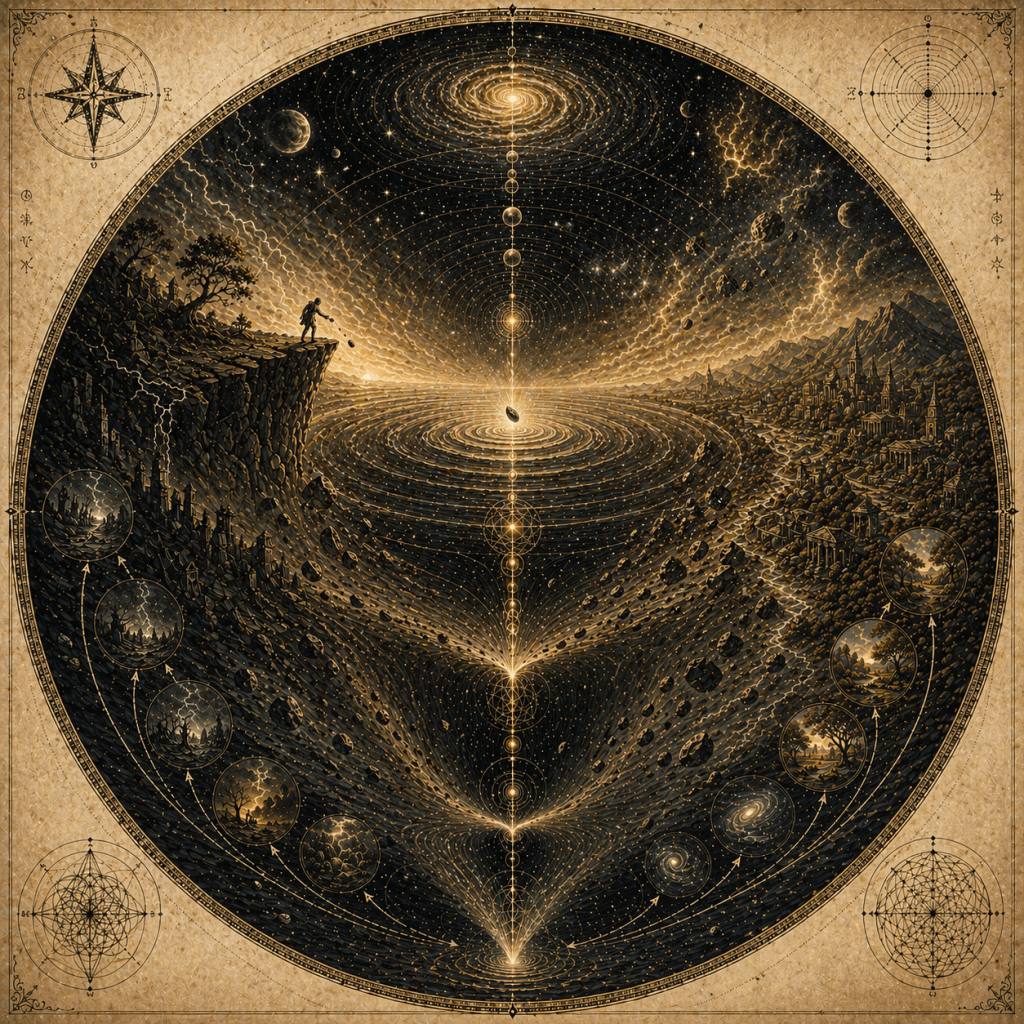
Section I: Invocation — The Paired Truths
Karma is the echo of the choices your Will makes, and the honor of carrying what your Will creates.
Dharma is the attunement of one’s Will to larger systems of collective Will, where choices align with principles that ring across cultures and through time.
These are not definitions in the usual sense. They do not offer clarity as closure or final words. They are entry points—thresholds into a living conversation about responsibility, liberty, and action in a world you shape with every choice you make.
Karma and dharma are often flattened into reward and punishment, obedience and fate. But in truth, they are mirrors for the Will. They do not dictate behavior; they ask something deeper: Are you aware of the weight of your actions? Are you in tune with the moment you are living?
In this essay, karma and dharma are not treated as doctrines but as tools of Will. They are not laws imposed from above, but principles drawn from within and echoed by the world around you. They make no demand—only a reminder: you are shaping the world by how you move through it.
These renderings are not the whole of karma and dharma as taught in the Buddhist or Hindu traditions. They are translations into the grammar of Will—adaptations meant to illuminate how these ancient ideas can live as practical tools of authorship. They simplify, yes, but not to diminish. They simplify so that the weight of the concepts can move with you in daily life, without requiring the whole edifice of doctrine.
So let us begin. Not to memorize. But to meet.
Section II: Karma — The Echo of Will
In the West, karma is often reduced to a cosmic vending machine—reward for good, punishment for bad. But karma is not divine revenge, nor is it fate. Karma is not watching. Karma is what remains. It is the truth that things do not simply happen to you—things happen because of you.
A harsh word spoken in anger may be forgotten by some, but its echo lingers. Karma is what stays behind, shaping the silence that follows. Every action—every word, every silence, every gesture—leaves a trace in the world and in Will. These traces are not tallied by an external judge; they are etched inside the pattern of you—your becoming. They are etched in you. You may think you’ve moved on, but the echo has not.
Karma is not just the residue of choice. It is the honor of carrying what your Will has etched. And the echo does not discriminate. The harsh word shouted in anger and the hand extended in care both remain. To claim the gift and disclaim the wound would be incoherent, for both were signed at the same gate. Karma carries every trace—what you regret, what you cherish, what you would rather forget. The honor is not in selecting only the noble echoes. The honor is in carrying them all, and choosing, with dharma, what to etch next. Responsibility here is not framed as burden, but as authorship. You are not rewarded for being good or punished for being bad. You are responsible for what you do and every effect that follows. That responsibility is not a cage—it is a sacred invitation. You are the source of what happens next, and what happens after that. Karma means you are not just a participant in the world; you are a shaper of it.
To carry what you have created is not merely to accept consequences—it is to stand inside your echo and own it. The consequences become part of you. Scars become reminders, not defining traits. Karma is not punishment; it is presence. It is the world remembering, and you remembering with it.
Section III: Dharma — The Liberty to Choose Well
If karma is the echo, dharma is the tuning fork—the pitch you test before striking your next note.
Dharma is not a job title, a caste duty, or a rigid code of rules. Nor is it simply “doing the right thing.” Dharma is subtler—and stronger. It is the attunement of one’s Will to larger systems of collective Will, such that you preserve the liberty to choose in alignment with principles that run deeper than mere approval or fear. These collective Wills exist at many scales—the family, the city, the nation, even the universe itself. Each exerts its own pull, and dharma is the art of discerning how to tune within them.
Where karma is the record of what you’ve caused, dharma is the clarity by which you choose what to cause next. To feel the urge to retaliate but answer with calm—that is dharma. It is not weakness. It is strength in tune with truth.
Dharma is not conformity but harmony. It is sensing the note that belongs and striking it—not because someone else commands you, but because you have refined yourself enough to hear it. And it shifts with context. The dharma of a healer differs from that of a soldier. The dharma of silence differs from the dharma of protest. Roles change, but the principle remains: honest attunement to the greater pattern.
At times, collective Wills collide. An army doctor tending to enemy soldiers may face anger from comrades who see betrayal. Yet the doctor acts because he knows that if roles were reversed, he would want his soldiers cared for. In that moment, his attunement is to something higher than national will—a more universal thread of goodness that binds all life.
Or consider a parent who once shouted in frustration, and still carries the echo of that moment. That is karma. Later, in a similar situation, the urge to raise the voice rises again. But this time, the parent pauses, breathes, and speaks with steadiness. That is dharma. The echo remains, but it does not dictate. The past is carried honestly, while the present is tuned differently.
True dharma is never performance, never obedience masked as virtue. It is tested by evidence, not by self-congratulation. It asks: Do my actions cause harm? Do I break promises? Do I take more than I give? Do I justify in myself what I condemn in others? To live in dharma is to falsify the hypothesis that you are the villain of the story—and to do so with evidence, not assumption.
Dharma is not command; it is chord. And when struck, it brings not just you, but the world around you, into a more whole resonance.
Section IV: Karma and Dharma Together — The Spiral of Becoming
Karma and dharma are not opposites. They are partners in the spiral of becoming.
Karma is the pattern your choices leave behind. Dharma is the pattern you listen for before you act again. Karma remembers what you have done. Dharma asks what you are willing to do now.
Split apart, each loses its strength. Without dharma, karma becomes a trap—a cascade of effects repeating without your authorship, echoes you cannot seem to escape. Without karma, dharma becomes weightless—an aspiration with no proof, no consequence, no root in the world.
Together, they form a spiral. Every action leaves a trace that shapes the next moment. Every new moment offers the chance to choose differently, to tune more honestly. If you are honest, the past will shape your future. If you are honest, you will shape a past worth carrying forward—a past that bends the future toward the present you want.
This is not fate. This is authorship.
You are not what you have done. You are what you do now, given what you have done. You are not your echoes alone. You are the voice that shapes the next note, the Will that chooses what the spiral becomes.
And in this—echo carried, choice made, new echo formed—you are transformed. The cycle is not a loop; it is a spiral. Each turn deepens. Each turn makes you more than you were.
That deepening is what makes it a spiral rather than a circle. A circle repeats without remainder; a spiral carries memory. You do not return to the same place—you return changed, able to sign differently because of what you have already carried.
Here’s a full draft of the new Section V written to slot directly into Essay 004, between Section IV and the Conclusion. I kept the rhythm and tone consistent with what you’ve already built.
Section V: Inherited Karma — Substrate Tilt and Responsibility
Not all echoes were authored by you. Some were etched before you could choose—scars left by others’ hands, or by the accidents of birth. This is inherited karma or substrate tilt.
Substrate tilt is not reward or punishment. It is the unchosen weight carried forward into your gate—the trauma carved before you could speak, the genetic storms set in motion before you were born, the echoes of violence witnessed in a home where you had no power to intervene. These too shape the thresholds of your Will. They alter how easily the gate opens or shuts. They bend the ground upon which your choices stand.
Yet the law does not dissolve. The echo may not be of your making, but how you carry it becomes your authorship. Dharma here is not about obedience to fate; it is about choosing how to hold what was handed to you. You cannot erase the mark, but you can decide whether to amplify it, transmit it, or end it.
This is where the distinction between personal responsibility and legal culpability must be sharpened. They are not the same.
Consider two edge cases.
The first: a man who murders after years of watching his father murder. The trauma scarred him deeply. His echoes are not only his own, but those imposed by another. Still, when he takes a life, he authors that act. He is personally responsible. And he is legally culpable, because society cannot excuse or quickly erase what has been done. His reintegration demands long, arduous rehabilitation, if it is possible at all.
The second: a woman who murders during a psychotic break. Her logic gates are real; her authorship still passes through them. She is personally responsible for what occurred. But she may not be legally culpable. Medication or treatment may stabilize her quickly, allowing her to rejoin society without the same long shadow of mistrust. The law makes a distinction here—not because she lacked a gate, but because her substrate debt is treatable in ways trauma is not.
Both acts passed through thresholds. Both were authored. But the echoes they leave behind are carried differently—by the self, by the community, by the law. Karma means the authorship is never erased. Dharma means the responsibility is to carry these echoes without passing them forward in further harm.
Substate tilt is not a loophole in responsibility; it is a deeper test of it. To claim your sovereignty is to face not only the echoes you created, but the echoes imposed on you. To carry them with honesty. To choose healing where you can. To refuse to let another’s bad choices dictate the shape of your own Will.
The spiral carries both your authored echoes and your inherited ones. In each, your authorship lies in how you choose to carry them forward.
The spiral does not wait for your perfection. It waits for your authorship—authorship that must hold steady even when the gate you inherited is fractured. The question that follows is how that responsibility can be claimed, scaled, and made durable.
Section VI: Conclusion — The Path and the Practice
Karma is not superstition, and dharma is not dogma. They are not abstract doctrines, but living principles woven into every action, every threshold of choice. You do not need to believe in past lives to feel the echo of yesterday’s decision. You do not need scripture to recognize when your actions are out of tune with what is good.
What matters is presence. To recognize that your choices leave a mark. To recognize that you are not bound by those marks, but that you hold the liberty to shape how you carry them. To recognize that you are part of a greater whole—and that liberty is not doing whatever you want, but choosing in resonance with what is true.
Karma is the echo of the choices your Will makes—and the honor of carrying what your Will has created.
Dharma is the attunement of your Will to larger systems of collective Will, where your choices align with principles that endure across cultures and time.
These are not beliefs to adopt. They are tests of Will. Tests etched not in abstract thought, but in the life you live, in the consequences you bear, in the next step you choose.

