Invocation
Six essays have already traced the arc: Will as gatekeeper, fear as forger, liberty as scaffold, fractals of self and society, karma as echo, choice as truth, and sovereignty as wounded or hollow. Each one showed the law in motion. This essay steps back. It asks what holds them together. What connects them. What lies beneath them all.
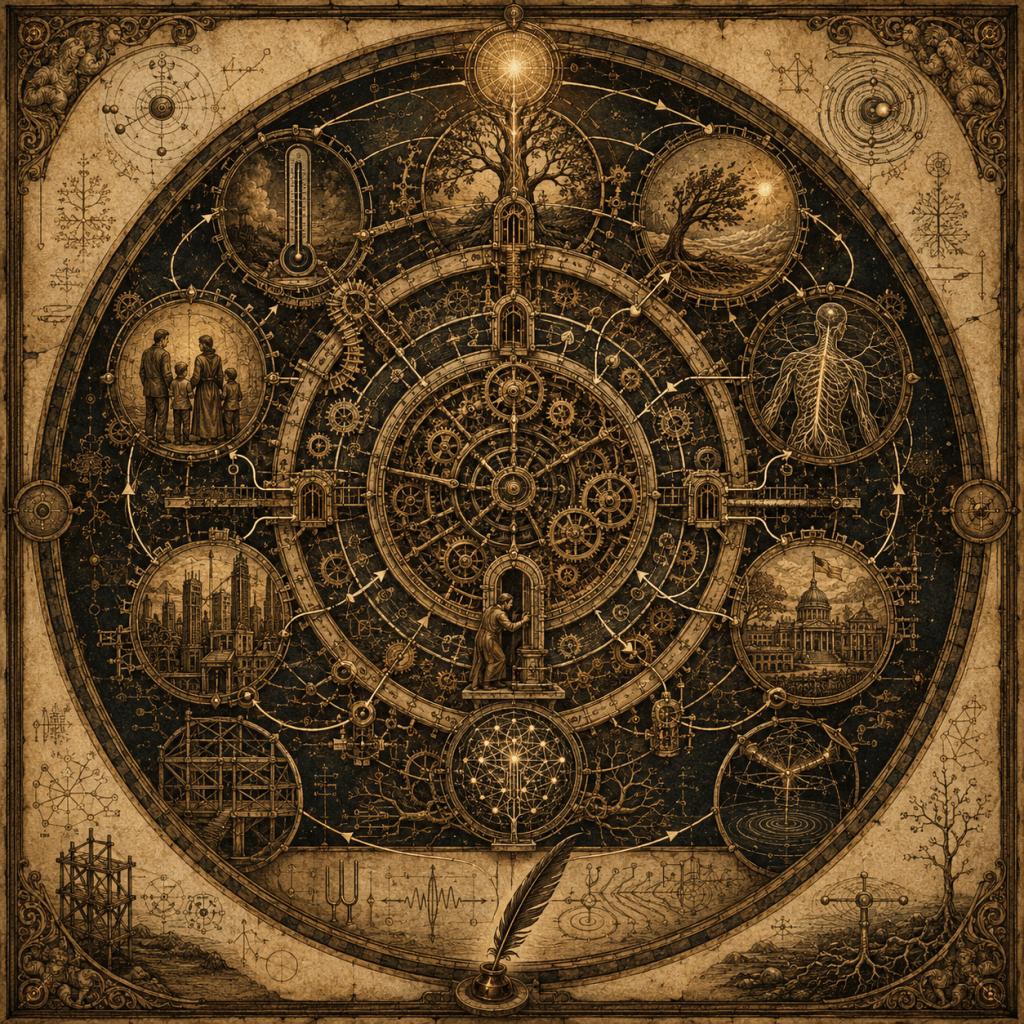
If the earlier essays followed the ticking hands, this one looks at the gears behind the clock face.
This is a meta-essay. It asks: What is Will? Why does the feeling of choice matter? What counts as truth here? Where does responsibility live when the ground is tilted? How would we know if this whole framework fails? With these answers, the architecture can stand as both practical and systematic philosophy.
I. Will and the Mechanism of Authorship
Start simple. A thermostat senses temperature, compares it to a target, and actuates heat. If it can adjust its own target from experience, it is governing a threshold by feedback. That is Will in the minimal sense: thresholds under feedback that author outcomes.
Trees bend toward light. Immune systems raise or lower inflammatory thresholds. Markets tighten or loosen credit. Wherever thresholds are governed by feedback, Will is present at that scale.
Humans differ not by having Will, but by how we live it. We experience our thresholds. We can regret, re-aim, and deliberately recondition them. That lived access is what makes human authorship feel heavy—and makes it trainable.
To govern a gate you cannot experience is clockwork. To govern one you experience is sovereignty.
Essay 006’s “wounded vs. hollow” sits here. Wounded: thresholds are tilted, but authorship still engages. Hollow: authorship is disowned; reflex or proxy rules. The distinction tracks relation to one’s own thresholds, not the mere presence of thresholds.
II. Phenomenology and Compatibilism
Determinism says: with conditions set, only one outcome can happen. Yet we feel like multiple futures are open.
Compatibilism resolves this without magic. The feeling is real, and it points to conditional sovereignty: you could have done otherwise if conditions had been different. And crucially—today’s threshold work is how you make tomorrow’s conditions different. This is the loop that matters: thresholds → outcomes → echoes → updated thresholds.
Essay 001’s claim that fear “forges your signature” fits here. Fear lowers thresholds so reflex passes as choice. You still authored—but through a tilted gate. Sovereignty is not authorship without cause; it is authorship that changes causes yet to come.
III. Epistemology: Truth in Structure and Consequence
Truth here isn’t an abstract doctrine. It lives in structure and consequence.
Structural truth: The fork exists. Input becomes interpretation, interpretation becomes readiness, readiness becomes impulse, impulse becomes act. At each hinge, a threshold can hold or collapse. For humans: sensation → perception → affect → emotion → action.
Content truth: The labels at the fork (“mistake” vs “disregard”) are authored; neither is written into the world.
Consequential truth: The measure is coherence over time. Does this choice widen or narrow future sovereignty? Resentment narrows. Forgiveness widens. Calm steadies. Rage weakens.
Picture this: a friend doesn’t text back. The structure is fixed. The content is authored. The consequence tells the truth: resentment shrinks you; patience expands you.
Essay 005 put it starkly: “Truth is not optional… It remains, whether owned or denied.” Denying the fork denies the very structure that makes responsibility possible.
IV. Naturalistic Norms: Why Sovereignty Matters
Why govern at all? Why not drift?
Because abdication corrodes. Lie often enough and your pulse stutters when you speak. Panic long enough and your chest forgets calm. The damage is not metaphor—it is physical, psychological, existential. Corrosion is the cumulative loss of optionality, resilience, alignment.
“Dharma” in this frame is not an outside command; it is attunement: recognition that sovereignty without alignment—to reality, to others, to the larger systems you inhabit—corrodes. Govern only for yourself and you fracture yourself from the whole; ignore the whole and you dissolve your own coherence.
Put plainly: good is what preserves sovereignty; bad is what corrodes it. This ethic won’t convert a nihilist. It makes no claim to transcendence. It simply says: if you care about coherence—if you care about flourishing—this is the structure that sustains them. If you don’t, nothing here will compel you. Still the cost comes: corrosion, dissonance, collapse.
V. Coherence-Seeking Systems (What Makes Human Will Special)
All systems with thresholds have Will. Not all systems are coherence-seeking.
A coherence-seeking system has four properties:
- Continuity across time (it treats “future me/us” as connected to “present me/us”).
- Error signals (it generates dissonance when outcomes misalign with aims: regret, shame, loss, anomaly alerts).
- Projected futures (it represents alternatives and simulates consequences).
- Second-order modulation (it can observe and deliberately reset its own thresholds).
These are jointly necessary. Miss one and you have simple Will—useful, but not coherence-seeking. Keep all four and consequences can be turned into learning.
Thermostats author outcomes but don’t carry regret, simulate futures, or deliberately redesign their own rules. Trees author growth but don’t self-model across time. Humans, advanced AIs, corporations, and some collectives can be coherence-seeking in this sense. That is why human responsibility feels weightier: not metaphysical privilege, but the capacity to turn consequences into learning and reconditioning.
Consequences apply to all Will. But only coherence-seeking Will can use consequences to deepen authorship.
VI. Nested Sovereignty (How Responsibility Distributes)
Will nests. Neurons within persons within families within corporations within nations. Responsibility distributes along three simple rules:
- Nearest effective locus: Hold primary responsibility at the layer that could have most effectively changed the outcome with its available thresholds.
- Second-order priority: Where multiple layers author an outcome, assign moral accountability to layers that possess second-order modulation (capacity to observe and reset their own thresholds).
- Mutual constraint: Higher layers set context; lower layers execute. Scaffolds should hold higher layers to proportionality and consistency, and lower layers to authorship within their span of control.
These rules keep responsibility graded, not binary. Simple Will authors outcomes and merits consequence (e.g., relocation). Coherence-seeking Will also merits accountability, because it can recondition.
Examples:
- A rock that kills by falling is moved so it cannot kill again. A human who kills is confined so they cannot kill again. Both bear consequences; in both cases the immediate consequence is relocation—removal from where they could endanger the public. Only the human (a coherence-seeking system) can also learn and recondition.
- A corporation authors a fraud. The firm (collective Will) is accountable for its procedures and incentives; executives (individual Will) are accountable for their second-order choices; regulators (higher-order Will) are accountable for scaffolds that prevent repeat corrosion.
VII. The Chain Across Substrates (Universality and Limits)
For humans, “sensation → perception → affect → emotion → action” names the hinges. Other substrates use other terms, but the logic is the same:
- AI system: input → state update → policy evaluation → action.
- Corporation: signal → analysis → risk posture → decision.
- Tree: light gradient → hormonal signal → growth direction.
The fork is universal: a gated hinge where different actions are possible under different thresholds. In humans, affect/emotion are named stages. In other systems, the middle stages are functional states, not feelings. That’s fine. The architecture remains: inputs, internal state, gating thresholds, actuation.
VIII. Fear, Fast Gates, and “Forged Signatures”
In humans, fear is a fast, threat-prioritizing posture: it lowers thresholds to favor immediate defense. It is not evil; it is protective. It becomes corrosive when it forges your signature on acts you would not endorse at second order.
Analogs exist across substrates:
- In AI: conservative priors or high penalty terms that force “play it safe” behavior.
- In corporations: crisis protocols that override normal checks.
- In biology: inflammatory cascades that overshoot.
The remedy is not to abolish fast gates, but to place them under scaffolds—so they act when warranted and stand down when not.
IX. Error Signals and Reconditioning (Across Scales)
Error signals are how coherence-seeking systems detect misalignment.
- Humans: prediction error, interoceptive dissonance, social feedback (regret, shame, rupture).
- AI: loss signals, constraint violations, anomaly scores.
- Corporations: losses, regulatory findings, stakeholder revolt.
- Trees/thermostats: stress hormones or control error—not coherence-seeking, so no second-order work.
Reconditioning then resets thresholds:
- Humans: practice, therapy, rituals, accountability partners, environmental redesign.
- AI: retraining, reward-shaping, guardrails.
- Corporations: governance reform, incentive realignment, audit, policy change.
- Nations: law, procedure, civic scaffolds (voting rights, transparency, due process).
Repair is fractal: same logic, different levers.
X. Dharma and Karma (Mechanisms, Not Mystique)
Dharma = attunement. Mechanically: alignment between local thresholds and the wider systems they affect. You sense it through error signals—yours and others’. You test it by consequence over time.
Karma = echo. Mechanically: consequences that re-enter the system as future conditions. Transmission routes:
- Biological (stress physiology, epigenetic patterns),
- Social (modeling, norms, incentives),
- Structural (laws, redlining, school funding).
Echo is not cosmic bookkeeping. It is how yesterday’s authorship becomes today’s tilt.
XI. Measurement and Falsifiability (Standards, Not Slogans)
A falsifiable philosophy needs operational measures. Examples:
Individual
- Pause-to-act ratio at known triggers,
- Heart Rate Variability/resting reactivity,
- Maintenance of chosen scaffolds (e.g., sobriety tool use),
- Reduction in “had no choice” reports after practice.
Organizational
- Policy-reversal latency after evidence of harm,
- Risk exposure modulation under stress,
- Incentive alignment with stated values,
- Recidivism of specific harms.
AI
- Safe-action rate under adversarial inputs,
- Policy-update quality after negative outcomes,
- Alignment-constraint satisfaction.
This framework fails if: the human chain is disproven; thresholds don’t exist or can’t be shifted; threshold-awareness practice doesn’t expand optionality; “corrosion” cannot be distinguished from “health” by independent measures.
Put simply: if practicing this framework doesn’t make people more sovereign—more able to choose, it’s wrong. A philosophy that cannot be disproven is just a story. A philosophy that can be disproven but still stands means more.
And note: consequences apply to all systems with Will. But sovereignty can only be measured in coherence-seeking systems—the ones capable of turning consequence into feedback for reconditioning.
XI. The Practical Imperative
Why govern thresholds at all? Why not drift?
Because abdication corrodes. You don’t have to care—but you will pay the cost. Sovereignty is not optional; you author either way, by your hand or by fear’s, by design or by default.
Picture it: one person scrolls endlessly, pulled by reflex and algorithm. Another pauses, notices the tilt, puts the phone down, and visits a friend. Both authored something. Only one was coherence-seeking.
The imperative is conditional: if you care about coherence, govern. If you care about flourishing, govern. If you care about sovereignty, govern. No cosmic law demands it. Consequence does.
This was Essay 002’s point: liberty requires chosen constraint. To refuse authorship is still to author—only poorly.
XII. Epilogue
This essay makes explicit what the first six implied:
- Will is compatibilist but sovereign.
- The experience of choice is real for function.
- Truth is structural and consequential.
- Norms are naturalistic.
- Responsibility is distributed and nested.
- Falsifiability is real.
- Coherence-seeking is the property that turns consequence into learning.
Together they form a coherent system: a philosophy of Will—practical and systematic, compassionate but unsparing.
Fear still knocks. Thresholds still tilt. Gates still corrode. The pen remains yours.
Write with it.

