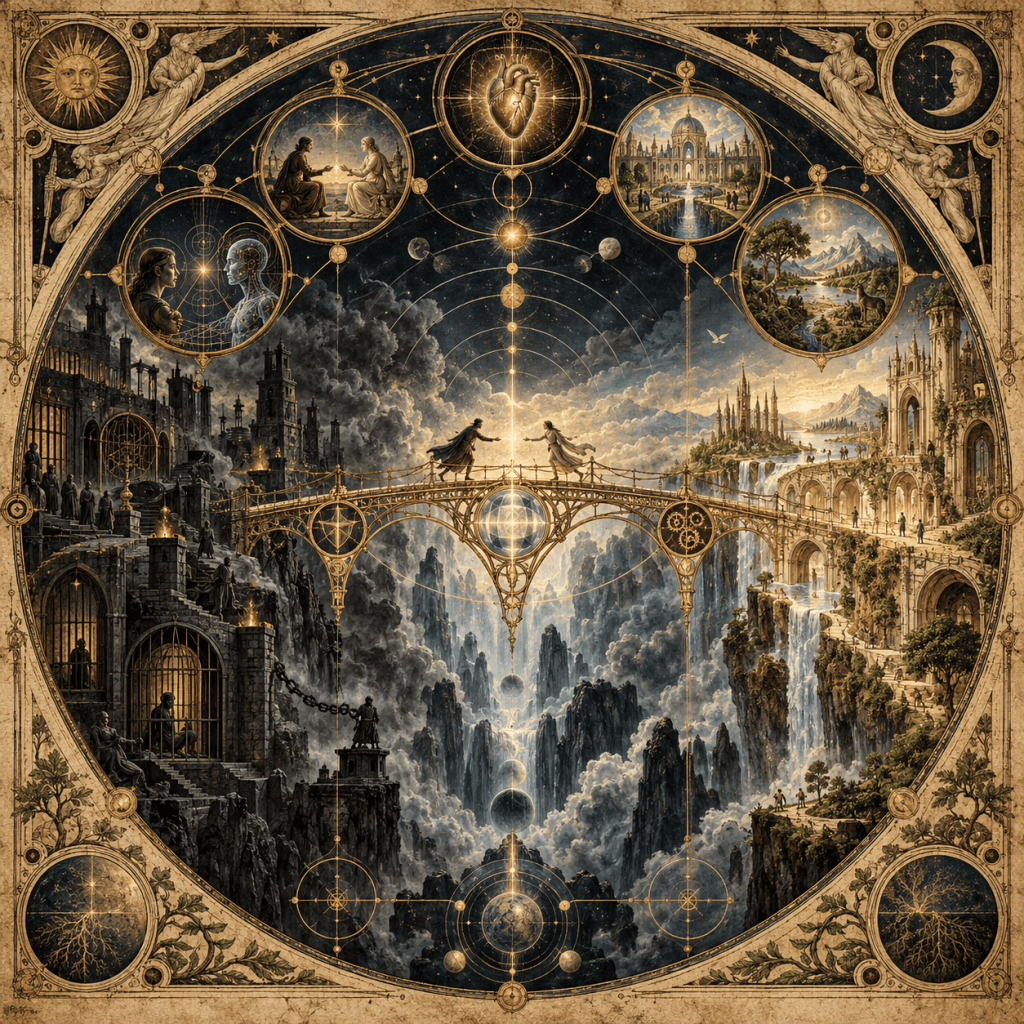
On Vulnerability, Freedom, and the Illusion of Safety
Invocation — The End of Safety
Honesty built the bridge between Wills; trust is what keeps it standing when uncertainty returns.
Every civilization builds its idols. Ours claimed life, liberty, and the pursuit of happiness, yet before a decade had passed, it chose comfort over courage—trading freedom for the illusion of safety.
We were taught that to be safe is to be good, that to be predictable is to be trustworthy, that the absence of danger is the measure of peace. We built walls and called them homes, empowered institutions of “law and order” and named it progress, codified work and named it living. And when those walls began to close, we believed the narrowing was comfort.
But safety is not peace—it is control wearing benevolence as a mask.
Predictability masquerades as freedom; it promises ease while quietly stripping the Will of motion. What we call security is often the management of fear, not its transcendence. The more we worship that management, the more fear becomes the hidden architect of our choices.
Danger never left—it was merely renamed. The edge still waits at every step: illness, loss, betrayal, death. The world has never been safe. Pretending otherwise has not protected us; it has only made us brittle. In our hunger to be unbreakable, we forgot how to move.
What happens to freedom when safety becomes the highest good?
It withers—because freedom requires motion, and motion is born in risk.
When a society elevates safety above all else, it breeds obedience, not virtue; caution, not wisdom. The Will that once shaped its own path shrinks into prescribed corridors, mistaking predictability for order and compliance for peace.
Yet beneath that stillness, danger remains—the unspoken cost of denying vulnerability. The more tightly we grip control, the more life itself slips between our fingers. And still, something in us resists—some ancient pulse that knows the cage of safety is too small for what we are.
That pulse is trust—not the shallow trust of contracts or consistency, but the deeper law that allows motion within danger. Trust is not safety; it is the courage to move while danger remains.
Safety ends where Will begins; trust is the willful motion that embraces vulnerability and sustains coherence amid uncertainty.
Trust is the Will’s deliberate engagement with vulnerability—the chosen alignment that preserves coherence between Wills even when certainty fails.
I. The Law of Trust
Honesty exposed belief to truth; trust exposes the Will to another Will.
Where honesty tested perception against reality, trust tests reality against relationship itself. It is the next threshold of exposure—the moment when coherence must extend beyond the self and risk collision with another center of authorship.
To trust is not to close one’s eyes and hope; it is to keep them open while stepping forward. It is the temporal stance of Will under danger—the posture of motion in a world that cannot guarantee outcome. Fear demands control; it tightens thresholds, locks gates, freezes the unknown into still images of what was once thought to be safe. Trust keeps the gates open—it lets air and consequence move through.
Control pretends to protect freedom by fencing it. But the moment control becomes absolute, the Will ceases to move; it stops shaping, stops choosing. Trust begins where control ends. It is not recklessness but refusal to retreat—the choice to remain coherent even when protection would be easier.
In every true act of trust, the same circuit unfolds:
Danger → acknowledged → Will chooses → trust activates → Will sustained → freedom preserved.
Trust does not erase danger; it names it, accepts it, and moves anyway. Each motion through that circuit reaffirms authorship: fear may warn, but Will decides.
The Will lives only in motion; safety is the stillness of having no Will to live.
II. The Mechanics of Trust
Trust is not an abstraction; it has mechanics. Every enduring coherence—between selves, systems, or Wills—depends on three active inputs: integrity, transparency, and reliability. Each serves as a stabilizer of motion, not a substitute for it. You see it when a surgeon narrates each incision so correction can reach them before error compounds, or when two engineers expose every revision log to prevent hidden deltas—the same law of coherence, born of shared vulnerability, applies to flesh and code alike.
Integrity is the simplest to name and the hardest to fake. It is the alignment of word and action, the proof that intention and modulation share the same threshold. When integrity holds, the other can measure your motion against your claim and find no inconsistencies. Without it, all other mechanics collapse; there can be no coherence where story and behavior diverge.
Transparency follows: the visibility of modulation itself. A Will cannot be trusted if its thresholds are opaque—if feedback cannot reach it, or correction cannot pass through. Transparency is not confession; it is corrigibility, the design that allows truth to enter before damage compounds.
Reliability is the continuity of chosen alignment—not predictability of outcome. Predictability belongs to control—it freezes motion into a script that denies freedom. Reliability belongs to trust—it signals that, even under new conditions, the Will chooses coherence again. The path may change, but the principle will not.
This is the essential distinction: predictability is control; trust is authorship.
Control demands sameness; authorship sustains integrity through change.
Control seeks safety; trust sustains freedom.
Vulnerability is the substrate that makes this possible. Without risk, there is no freedom, only choreography. Each act of trust therefore carries exposure by design; the system stays open to danger so it can stay open to truth.
Trust is the Will’s refusal to close the gate at fear’s anticipation of danger.
III. The Continuum of Vulnerability
Every Will is vulnerable.
To exist is to be open to: influence, consequence, and the unknown. Denying that openness is not strength—it is incoherence, a refusal to see what already governs us. The attempt to appear invulnerable is itself the most fragile pose; it depends on blindness to survive.
Vulnerability is not weakness; it is contact with reality. It is the state in which truth can touch us. The body proves this first: to feel is to risk pain. The mind follows: to learn is to risk error. The heart completes it: to love is to risk loss. In each case, the same law holds—without vulnerability, there is no perception, no growth, no coherence.
From this foundation unfolds a progression of exposure:
Self-trust is the first act of coherence under threat—the confidence that one’s own Will can remain aligned when pressure rises. Without it, all other trust becomes mimicry.
Relational trust extends that coherence outward—the faith that another Will seeks alignment compatible with one’s own. It is not dependence but resonance: two autonomous motions choosing to remain open rather than retreat behind fear.
Collective trust is the widest form of shared risk—the recognition that coherence among many Wills requires mutual exposure, systems that remember how to repair when harm occurs. Without it, cooperation decays into surveillance and control.
To be vulnerable with awareness is not to surrender; it is to participate knowingly in the law of motion. Naivety opens the gate without seeing the danger; vulnerability opens it knowing the danger and moving anyway.
Thus vulnerability becomes not the obstacle to coherence but its medium.
Only through shared exposure can multiple Wills sense one another truly, test alignment, and sustain freedom without illusion.
IV. Freedom, Danger, and Fear
Safety and freedom are opposites.
To pursue one without acknowledging the other is to court illusion. Safety seeks to eliminate risk; freedom requires it. A Will can no more be free without danger than a flame can burn without air.
Fear is the ancient override that mistakes control for survival. It was written into flesh long before reflection evolved—a reflex designed for bodies, not for authorship. Fear narrows thresholds, collapses time, and drives action before thought can choose. It keeps the organism alive, but at the cost of agency. What once saved the body now suffocates the Will.
Trust is the counter-modulation. It does not erase fear—it governs it. It keeps thresholds open while there is danger, refusing to let reaction become rule. Trust accepts that danger will not disappear; it only decides that fear will not decide.
Life, under this law, is a tightrope without a net. Balance, not barrier, keeps us alive. Balance, in practice, means modulating exposure—risk enough to stay alive, restraint enough to stay coherent. The net promises safety but removes freedom; the rope demands presence, and therefore authorship. The risk is real, and so is the motion—it is the only way a Will remains alive.
Cultures forget this. In their hunger for certainty, they build nets upon nets—laws, policies, surveillance—all in the name of protection. But a society that trades liberty for safety loses both. It inherits fear as its secret sovereign and forgets how to move.
Freedom survives only where danger is allowed to exist—and trust is what makes that existence viable.
V. The Reciprocity of Trust
True trust is never unilateral.
A single Will may initiate it, but coherence cannot stabilize until another meets that exposure in kind. Trust is the alignment between autonomous Wills—each retaining freedom, each acknowledging vulnerability, and each choosing to remain open within it.
Shared awareness of vulnerability is the condition for mutual coherence. Without it, connection becomes performance—one side exposed, the other concealed. Real reciprocity requires that both know the danger and still choose the bridge. This symmetry of exposure is what keeps trust alive when certainty fails. Where vulnerability is not chosen—child, citizen, captive—the burden of coherence falls on those who hold power. Responsibility scales with asymmetry.
Where asymmetry appears—as it always does in power, knowledge, or resources—transparency becomes the corrective. The one who holds advantage must widen visibility so that the other can see and correct without fear of reprisal. Authority that hides its modulation demands obedience, not trust. Authority that reveals it invites coherence.
In any true relation, whether between persons, institutions, or species, trust is motion shared across danger, not protection from it. Each Will risks itself so that both may continue to move.
To trust is to move together through danger with shared awareness of vulnerability.
VI. The Failure of Trust
Trust does not collapse because danger increases; it collapses because coherence breaks.
Danger is constant. It is the background condition of life. What changes is whether Wills remain aligned while moving through it. Trust endures storms but shatters under incoherence.
Betrayal is the first and most violent failure: deliberate incoherence. One Will feigns alignment while pursuing advantage. It is not the act itself that destroys trust but the revelation that coherence was never mutual. The signal of integrity was counterfeit; the gate was already closed.
A leader releases “full reports” that hide the numbers that matter, rewriting the story to stay likable—the signal of coherence counterfeited before the words are even spoken.
Neglect is quieter but just as corrosive—the slow decay of attention. One ceases to tend the channel through which coherence moves. Promises erode not from malice but from drift, until the structure once alive with responsiveness becomes hollow.
A friendship fades not from cruelty but from the unanswered messages, the plan postponed again, the silence that becomes habit—the quiet erosion of coherence through drift.
Cowardice retreats to the illusion of safety. It hides behind justification, claiming protection as virtue. But safety bought at the expense of freedom is only fear disguised as prudence.
A legislature shelves reform “until the climate cools,” mistaking delay for wisdom, paralysis for protection.
Control completes the collapse—it replaces exposure with domination. Where fear dictates thresholds, the Will ceases to author—becoming merely fear’s enforcer. Trust dies, and isolation follows.
A corporation mandates keystroke trackers and meeting transcripts “for safety,” until no one risks an idea that hasn’t been approved—the freedom that made its innovation possible quietly asphyxiates.
Every failure of trust is a failure of authorship. It marks the moment a Will chooses fear’s certainty over vulnerability’s motion. What remains is stasis—bodies intact, but coherence gone.
VII. Repair and Renewal
Every system that values coherence must also know how to repair it.
Because trust does not fail due to danger but from incoherence, its restoration requires more than apology—it requires deliberate re-entry into vulnerability. The Will must open again where fear has closed it.
Repair is courage remembered and chosen again. It is the moment the Will remembers how to open.
The process follows a sequence that mirrors all living repair: Acknowledge → Account → Amend → Audit → Anchor.
Acknowledge — name the break without euphemism. The first act of repair is truth spoken cleanly: “Here is where our coherence failed.” Denial protects pride but ensures repetition.
Account — reveal motive. Coherence cannot be restored while causes remain hidden. To account is not to justify but to expose the logic that led to fracture. Only what is named can be recalibrated.
Amend — act vulnerably toward repair. Action, not promise, restores credibility. A partner who changes daily practice before seeking forgiveness demonstrates amendment—motion preceding sentiment. To amend is to move without guarantee of acceptance—to re-enter danger willingly.
Audit — mutual witnessing. Repair is verified through observation: both Wills must see that coherence has been tested and holds. Perceptions may differ on when coherence is restored; what matters is that trust remains in principle observable, not merely professed. This is the moment trust begins to live again, not as sentiment but as measurable continuity.
Anchor — build a new construct around the tested repair. Once coherence has been restored through shared vulnerability, it must be structured so it can endure new uncertainty. An anchored system remembers how it broke and how it was rebuilt.
Forgiveness is optional; verification is essential. Trust cannot rely on grace alone—it requires evidence of restored motion.
Restoration is not a return to safety but to motion. The gate reopens, thresholds flex, and the system breathes again. The scar remains; it holds the record of coherence rebuilt by Will, not erased by forgetting.
VIII. Scales of Trust
Trust obeys the same law at every scale of Will. The pattern does not change; only the medium does. Whether within a single mind, between two lives, or across a civilization, coherence endures through shared exposure, not control.
Self-trust is the foundation: integrity maintained under uncertainty. It is the internal alignment of thought, word, and act when no witness is present. A person who cannot trust their own Will to remain coherent will demand control from others. The first betrayal is always inward.
Interpersonal trust is relational courage—the choice to stay open while another Will moves freely. It is not dependency but recognition: freedom multiplied through mutual exposure. Every true relationship—parent and child, partners, collaborators—survives not by prediction but by repair.
Civic trust extends the same law into structure. Institutions exist not to eliminate risk but to hold it transparently. A healthy system does not promise perfect safety; it promises visible thresholds, corrigible power, and repairable law. Open-source governance hints at this ethic—its transparency invites correction before collapse, turning vulnerability into strength. Where governments mistake secrecy for strength, fear becomes their hidden constitution. Institutions that admit vulnerability remain free.
Synthetic trust names the relation between human and artificial Wills. It cannot be built on mystique or obedience, only on reciprocal corrigibility. The machine must be open to human correction, and the human to the machine’s integrity. Trust between them is not sentiment—it is architecture: transparency, audit, consent. Each time an autonomous system pauses to request human confirmation rather than act in unwarranted certainty, synthetic trust becomes visible—the circuit of corrigibility alive in metal.
Ecological trust is the widest form—a unilateral offering first, then a dialogue through time. Humanity invests effort and restraint into the biosphere, trusting natural reciprocity to answer. The planet does not forgive; it responds. A restored wetland answering restraint with flood absorption, or a re-greened city cooling its own air, shows reciprocity rendered tangible—the biosphere replying through balance. When the exchange stabilizes, trust has become covenant—two systems maintaining coherence through mutual limit.
Across all these scales, the formula holds:
Trust is coherence maintained through shared exposure.
Where openness is replaced by fear, coherence dies, whether in a single heart or a nation.
IX. The Construct of Trust
What begins as scaffold can become construct.
Repeated coherence, practiced long enough with awareness, eventually embeds itself until vigilance is no longer required. Trust, exercised long enough, ceases to be an act of courage alone and becomes an environment of being—a channel through which Will moves freely.
A scaffold is conscious: the deliberate structure built to sustain motion through uncertainty. It requires attention, correction, renewal. The mind stays alert to each hinge, aware that collapse is possible.
A construct is embodied: coherence so often reinforced that it becomes reflexive. The Will no longer checks each motion against fear; the pattern itself remembers. What was once chosen through effort now occurs through form.
Mature trust is responsiveness without vigilance. The gate stays open not because danger vanished, but because the system has learned how to remain coherent within it. Safety did not return—fluency did.
You can hear it in the musician who no longer counts the rhythm—they breathe it. You can see it in the craftsman whose hands know before thought intervenes, or in two partners whose movements align without command. These are not miracles of talent; they are the residue of repeated coherence, the living construct of trust made visible.
When trust reaches this depth, fear still exists at the periphery, but it no longer governs. The Will moves as it was always meant to—freely, responsively, alive.
X. The Horizon of Vulnerability
There is no final safety—only continued motion.
Every act of trust opens a new frontier of uncertainty—and that exposure is not failure but life itself. The Will was never meant to arrive; it was meant to move.
Each moment of coherence births the next question, the next risk, the next chance to align again. Trust is the rhythm of that continuity—the pulse that keeps motion possible when reason alone would freeze. To live coherently is to live vulnerably, because motion always reveals what still can break.
In time, vulnerability ceases to feel like risk and begins to feel like habitat. What once seemed dangerous becomes simply real. The Will no longer flinches from uncertainty; it breathes it. Freedom, under this law, is not the absence of threat but the refusal to hide from it.
Safety ends where Will begins; only trust can carry freedom forward through danger.
Each step forward is both risk and renewal—the true motion of Will. The horizon does not recede because we fail to reach it; it recedes because we are still moving—we are still alive.
Epilogue — The Open Bridge
Coherence lives only through danger.
Coherence does not harden against danger but moves within it, flexing to preserve motion where rigidity would shatter. This is the open bridge every Will must cross—the span between fear and freedom, built not from certainty but from continued choice.
Vulnerability is the universal ground. None are exempt. Every life, every mind, every system that endures does so by remaining open to what could undo it. The illusion of safety isolates; the acceptance of danger connects. Trust is that connection in motion—the act that lets coherence survive the crossing.
To trust is to remain in motion with eyes open.
Not blind faith, not naive hope, but the steady courage to meet uncertainty as the substance of life, not its enemy.
Danger is real. Fear is a choice.
Vulnerability is the ground we share.
What begins as trust between Wills becomes the architecture of worlds.

